Dracula’s Chivito (IRAS 23077+6707)

stsci_2025-025a December 23rd, 2025
Credit: Image: NASA, ESA, STScI, Kristina Monsch (CfA); Image Processing: Joseph DePasquale (STScI)
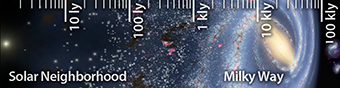
This Hubble Space Telescope image shows the largest planet-forming disk ever observed around a young star. It spans nearly 400 billion miles — 40 times the diameter of our solar system. Tilted nearly edge-on as seen from Earth, the dark, dusty disk resembles a hamburger. Hubble reveals it to be unusually chaotic, with bright wisps of material extending far above and below the disk—more than seen in any similar circumstellar disk. Cataloged as IRAS 23077+6707, the system is located approximately 1,000 light-years from Earth. The discovery marks a new milestone for Hubble and offers fresh insight into planet formation in extreme environments across the galaxy.
Provider: Space Telescope Science Institute
Image Source: https://hubblesite.org/contents/news-releases/2025/news-2025-025
Curator: STScI, Baltimore, MD, USA
Image Use Policy: http://stsci.edu/copyright/
-
 View Options

 Download Options
-
Full Size Image
(1276 x 1409)
Source TIFF (2.1 MB)
- Additional Sizes (JPG)
- 289 x 320 (29.8 KB)
- 927 x 1024 (122 KB)
- 452 x 500 (43.8 KB)
- 1159 x 1280 (175 KB)
 Image Details
 Distance

 Position Details
 Color Mapping





- ID
- 2025-025a
- Subject Category
- B.3.7.2.1
- Subject Name
- IRAS 23077+6707
- Credits
- Image: NASA, ESA, STScI, Kristina Monsch (CfA); Image Processing: Joseph DePasquale (STScI)
- Release Date
- 2025-12-23
- Lightyears
- 978
- Redshift
- 978
- Reference Url
- https://hubblesite.org/contents/news-releases/2025/news-2025-025
- Type
- Observation
- Image Quality
- Good
- Distance Notes
- distance in lightyears
- Facility
- Hubble, Hubble, Hubble, Hubble, Hubble, Hubble
- Instrument
- WFC3/UVIS, WFC3/UVIS, WFC3/UVIS, WFC3/IR, WFC3/IR, WFC3/IR
- Color Assignment
- Blue, Blue, Green, Green, Red, Red
- Band
- Optical, Optical, Optical, Infrared, Infrared, Infrared
- Bandpass
- Central Wavelength
- 438, 606, 814, 1050, 1250, 1600
- Start Time
- Integration Time
- Dataset ID
- Notes
- Coordinate Frame
- ICRS
- Equinox
- 2000.0
- Reference Value
- 347.45976151266, 67.39807115663
- Reference Dimension
- 1276.00, 1409.00
- Reference Pixel
- -285.78549892322, 930.45845738046
- Scale
- -0.00001099098, 0.00001099098
- Rotation
- 0.28998346864
- Coordinate System Projection:
- TAN
- Quality
- Full
- FITS Header
- Notes
- World Coordinate System resolved using PinpointWCS 0.9.2 revision 218+ by the Chandra X-ray Center
- Creator (Curator)
- STScI
- URL
- http://stsci.edu
- Name
- Space Telescope Science Institute Office of Public Outreach
- outreach@stsci.edu
- Telephone
- 410-338-4444
- Address
- 3700 San Martin Drive
- City
- Baltimore
- State/Province
- MD
- Postal Code
- 21218
- Country
- USA
- Rights
- http://stsci.edu/copyright/
- Publisher
- STScI
- Publisher ID
- stsci
- Resource ID
- STSCI-H-p25025a-f-1276x1409.tif
- Resource URL
- https://mast.stsci.edu/api/latest/Download/file?uri=mast:OPO/product/STSCI_PR_2025-025/STSCI-H-p25025a-f-1276x1409.tif
- Related Resources
- Metadata Date
- 2026-02-24T16:09:45-05:00
- Metadata Version
- 1.2
Detailed color mapping information coming soon...