Cloud 9, Starless Gas Cloud

stsci_2026-001a January 5th, 2026
Credit: Science: NASA, ESA, VLA, Gagandeep Anand (STScI), Alejandro Benitez-Llambay (University of Milano-Bicocca); Image Processing: Joseph DePasquale (STScI)
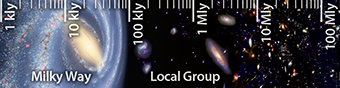
This image shows the location of Cloud-9, which is 14 million light-years from Earth. The diffuse magenta is radio data from the ground-based Very Large Array (VLA) showing the presence of the cloud. The dashed circle marks the peak of radio emission, which is where researchers focused their search for stars. Follow-up observations by the Hubble Space Telescope’s Advanced Camera for Surveys found no stars within the cloud. The few objects that appear within its boundaries are background galaxies. Before the Hubble observations, scientists could argue that Cloud-9 is a faint dwarf galaxy whose stars could not be seen with ground-based telescopes due to the lack of sensitivity. Hubble’s Advanced Camera for Surveys shows that, in reality, the failed galaxy contains no stars.
Provider: Space Telescope Science Institute
Image Source: https://hubblesite.org/contents/news-releases/2026/news-2026-001
Curator: STScI, Baltimore, MD, USA
Image Use Policy: http://stsci.edu/copyright/
-
 View Options

 Download Options
-
Full Size Image
(2914 x 1790)
Source TIFF (6.75 MB)
- Additional Sizes (JPG)
- 320 x 196 (24.4 KB)
- 1280 x 786 (143 KB)
- 500 x 307 (35.6 KB)
- 1600 x 982 (218 KB)
- 1024 x 629 (97 KB)
 Image Details
 Distance

 Position Details
 Color Mapping





- ID
- 2026-001a
- Subject Category
- C.5.1.6
- Subject Name
- Cloud-9
- Credits
- Science: NASA, ESA, VLA, Gagandeep Anand (STScI), Alejandro Benitez-Llambay (University of Milano-Bicocca); Image Processing: Joseph DePasquale (STScI)
- Release Date
- 2026-01-05
- Lightyears
- 14,000,000
- Redshift
- 14,000,000
- Reference Url
- https://hubblesite.org/contents/news-releases/2026/news-2026-001
- Type
- Observation
- Image Quality
- Good
- Distance Notes
- distance in lightyears
- Facility
- Hubble, Hubble, VLA
- Instrument
- ACS/WFC, ACS/WFC, -
- Color Assignment
- Cyan, Orange, Magenta
- Band
- Optical, Optical, Radio
- Bandpass
- Central Wavelength
- 606, 814, -
- Start Time
- Integration Time
- Dataset ID
- Notes
- Coordinate Frame
- ICRS
- Equinox
- 2000.0
- Reference Value
- 192.97742146935, 40.31162141639
- Reference Dimension
- 2914.00, 1790.00
- Reference Pixel
- 1412.09349782600, 1913.78149454300
- Scale
- -0.00001386141, 0.00001386141
- Rotation
- -46.93448411138
- Coordinate System Projection:
- TAN
- Quality
- Full
- FITS Header
- Notes
- World Coordinate System resolved using PinpointWCS 0.9.2 revision 218+ by the Chandra X-ray Center
- Creator (Curator)
- STScI
- URL
- http://stsci.edu
- Name
- Space Telescope Science Institute Office of Public Outreach
- outreach@stsci.edu
- Telephone
- 410-338-4444
- Address
- 3700 San Martin Drive
- City
- Baltimore
- State/Province
- MD
- Postal Code
- 21218
- Country
- USA
- Rights
- http://stsci.edu/copyright/
- Publisher
- STScI
- Publisher ID
- stsci
- Resource ID
- STSCI-H-p26001a-f-2914x1790.tif
- Resource URL
- https://mast.stsci.edu/api/latest/Download/file?uri=mast:OPO/product/STSCI_PR_2026-001/STSCI-H-p26001a-f-2914x1790.tif
- Related Resources
- Metadata Date
- 2026-07-20T12:48:58-04:00
- Metadata Version
- 1.2
Detailed color mapping information coming soon...