Abell S103 with Pullout of GLIMPSE-17775 (NIRCam Image)

stsci_2026-119a June 10th, 2026
Credit: NASA, ESA, CSA, Vasily Kokorev (University of Texas at Austin), Alyssa Pagan (STScI).
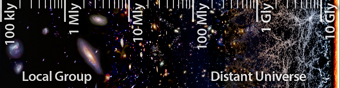
The little red dot that would come to be known as GLIMPSE-17775 was fortunately included in NASA’s James Webb Space Telescope’s field of view as it was observing galaxy cluster Abell S1063 for a different scientific purpose. GLIMPSE-17775 is located behind the galaxy cluster and has a cosmological redshift of 3.5, meaning it existed about 1.8 billion years after the big bang.
Since galaxy clusters like Abell S1063 are some of the most massive objects in the universe, light emitted by objects farther away can become distorted as it reaches the telescope. This effect is known as gravitational lensing. The combination of Webb’s 30 hours of observing time and gravitational lensing enabled scientists to obtain the deepest spectrum to date of a little red dot. The result: the strongest evidence to date of a hot, dense gas cocoon known as a “black hole star.”
Provider: Space Telescope Science Institute
Image Source: /image/stsci/2026-119a
Curator: STScI
Image Use Policy: http://stsci.edu/copyright/
-
 View Options

 Download Options
-
Full Size Image
(4199 x 4199)
Source TIFF (50.5 MB)
 Image Details
 Distance

 Position Details
 Color Mapping
| Telescope | Spectral Band | Wavelength | |
|---|---|---|---|

|
Webb (NIRCam) | Infrared (F090W) | 902.0 nm |
|
|
Webb (NIRCam) | Infrared (F115W) | 1.2 µm |
|
|
Webb (NIRCam) | Infrared (F150W) | 1.5 µm |

|
Webb (NIRCam) | Infrared (F200W) | 2.0 µm |
|
|
Webb (NIRCam) | Infrared (F277W) | 2.8 µm |

|
Webb (NIRCam) | Infrared (F335M) | 3.4 µm |
|
|
Webb (NIRCam) | Infrared (F410M) | 4.1 µm |
|
|
Webb (NIRCam) | Infrared (F444W) | 4.4 µm |



- ID
- 2026-119a
- Subject Category
- C.5.5.3 D.5.4.6
- Subject Name
- Abell S103, GLIMPSE-17775
- Credits
- NASA, ESA, CSA, Vasily Kokorev (University of Texas at Austin), Alyssa Pagan (STScI).
- Release Date
- 2026-06-10T10:00
- Lightyears
- 4,000,000,000
- Redshift
- 4,000,000,000
- Reference Url
- /image/stsci/2026-119a
- Type
- Observation
- Image Quality
- Good
- Distance Notes
- Facility
- Webb, Webb, Webb, Webb, Webb, Webb, Webb, Webb
- Instrument
- NIRCam, NIRCam, NIRCam, NIRCam, NIRCam, NIRCam, NIRCam, NIRCam
- Color Assignment
- Blue, Blue, Blue, Green, Green, Red, Red, Red
- Band
- Infrared, Infrared, Infrared, Infrared, Infrared, Infrared, Infrared, Infrared
- Bandpass
- F090W, F115W, F150W, F200W, F277W, F335M, F410M, F444W
- Central Wavelength
- 902, 1154, 1501, 1990, 2762, 3362, 4082, 4421
- Start Time
- Integration Time
- Dataset ID
- Notes
- Coordinate Frame
- ICRS
- Equinox
- Reference Value
- 342.1837510279, -44.5299146122
- Reference Dimension
- 4199, 4199
- Reference Pixel
- 1995.93, 2107.10
- Scale
- -8.672437358956e-06, -8.665215838391e-06
- Rotation
- -62.934605
- Coordinate System Projection:
- TAN
- Quality
- Full
- FITS Header
- Notes
- Creator (Curator)
- STScI
- URL
- /image/stsci/2026-119a
- Name
- Space Telescope Science Institute Office of Public Outreach
- Telephone
- Address
- City
- State/Province
- Postal Code
- Country
- Rights
- http://stsci.edu/copyright/
- Publisher
- Publisher ID
- stsci
- Resource ID
- STSCI-J-p26119a-f-4199x4199.tif
- Resource URL
- https://mast.stsci.edu/api/latest/Download/file?uri=mast:OPO/product/STSCI_PR_2026-119/STSCI-J-p26119a-f-4199x4199.tif
- Related Resources
- Metadata Date
- 2026-06-08
- Metadata Version
- 1.2
Detailed color mapping information coming soon...