Terzan 5 (Webb and Hubble Image)

stsci_2026-123a June 16th, 2026
Credit: Image: NASA, ESA, STScI, Giorgia Zullo (University of Bologna), Francesco R. Ferraro (University of Bologna); Image Processing: Alyssa Pagan (STScI)
Terzan 5 is a stellar system orbiting within the Milky Way galaxy’s bulge, which is an incredibly bright, crowded central region of the galaxy. Not only are stars within the bulge tightly packed together — every bit of this region is laced with thick clouds of gas and dust.
NASA’s James Webb and Hubble Space Telescopes joined forces to study Terzan 5. Astronomers already knew that this star cluster was unusual in that it contained two stellar populations of very different ages – one that formed about 12 billion years ago and one that formed 5 billion years ago. New research found strong evidence for two more stellar populations, one that formed 3.8 billion years ago and another only 2.5 billion years ago. The research team also was able to determine the ages of the previously known stellar populations with unprecedented precision, finding that they formed 12.5 billion and 4.7 billion years ago.
This finding proved that Terzan 5 is not a globular star cluster, as originally classified. Instead, Terzan 5 belongs to a new category, known as a bulge fossil fragment — a self-contained, self-enriching stellar system with multiple star populations of different ages and with different iron abundances.
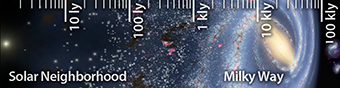
Terzan 5 is 22,000 light-years away in the constellation Sagittarius.
Provider: Space Telescope Science Institute
Image Source: /image/stsci/2026-123a
Curator: STScI
Image Use Policy: http://stsci.edu/copyright/
 View Options

 Download Options
 Image Details
 Distance

 Position Details
 Color Mapping





- ID
- 2026-123a
- Subject Category
- B.3.6.4
- Subject Name
- Terzan 5
- Credits
- Image: NASA, ESA, STScI, Giorgia Zullo (University of Bologna), Francesco R. Ferraro (University of Bologna); Image Processing: Alyssa Pagan (STScI)
- Release Date
- 2026-06-16
- Lightyears
- 22,000
- Redshift
- 22,000
- Reference Url
- /image/stsci/2026-123a
- Type
- Observation
- Image Quality
- Good
- Distance Notes
- Facility
- Hubble, Hubble, Webb, Webb
- Instrument
- ACS, ACS, NIRCam, NIRCam
- Color Assignment
- Blue, Cyan, Orange, Red
- Band
- Optical, Optical, Infrared, Infrared
- Bandpass
- F606W (Broad V), F814W (Broad I), F115W, F200W
- Central Wavelength
- 600, 801, 1154, 1990
- Start Time
- Integration Time
- Dataset ID
- Notes
- Coordinate Frame
- ICRS
- Equinox
- Reference Value
- 267.0233736161, -24.777347943
- Reference Dimension
- 4144, 3031
- Reference Pixel
- 2366.39, 1120.46
- Scale
- 8.544556856863e-06, 8.529035212692e-06
- Rotation
- 91.297066
- Coordinate System Projection:
- TAN
- Quality
- Full
- FITS Header
- Notes
- Creator (Curator)
- STScI
- URL
- /image/stsci/2026-123a
- Name
- Space Telescope Science Institute Office of Public Outreach
- Telephone
- Address
- City
- State/Province
- Postal Code
- Country
- Rights
- http://stsci.edu/copyright/
- Publisher
- Publisher ID
- stsci
- Resource ID
- STSCI-J-p26123a-f-4144x3031.tif
- Resource URL
- https://mast.stsci.edu/api/latest/Download/file?uri=mast:OPO/product/STSCI_PR_2026-123/STSCI-J-p26123a-f-4144x3031.tif
- Related Resources
- Metadata Date
- 2026-06-11
- Metadata Version
- 1.2
Detailed color mapping information coming soon...