Lion Nebula (MIRI image)

stsci_2026-127b August 10th, 2026
Credit: Image: NASA, ESA, CSA, STScI; Image Processing: A. Pagan (STScI)
NASA?s James Webb Space Telescope observed planetary nebula NGC 2392 with its MIRI (Mid Infrared Instrument) instrument, revealing the presence of dust and its varying structures within this tumultuous environment. Nicknamed the Lion Nebula due to its appearance, this collection of gas and dust is created and sculpted by the remains of a dying star, which is in the center and resembles the button nose of the lion.
While some dust is being destroyed by the bubble of ionized gas that forms the lion?s face, most of the gas is being ejected and migrating away from the star due to its radiation. In this image, cyan highlights the lion?s mane, which is the interior of a dust shell that is being illuminated by the central star. Within the mane, toward its edges, are purple clumps that look like they have cometary tails. These fluffy structures are also dust, which have managed to survive so far and protect the structures behind them.
Provider: Space Telescope Science Institute
Image Source: https://science.nasa.gov/asset/webb/lion-nebula-miri-image/
Curator: STScI
Image Use Policy: http://stsci.edu/copyright/
-
 View Options

 Download Options
-
Full Size Image
(984 x 717)
Source TIFF (2.03 MB)
- Additional Sizes (JPG)
- 320 x 233 (21.5 KB)
- 1024 x 746 (79.6 KB)
- 500 x 364 (32.1 KB)
- 1280 x 932 (108 KB)
 Image Details
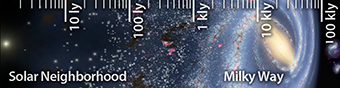
 Distance

 Position Details
 Color Mapping





- ID
- 2026-127b
- Subject Category
- B.4 B.4.1.3
- Subject Name
- NGC 2392, Lion Nebula, Caldwell 39
- Credits
- Image: NASA, ESA, CSA, STScI; Image Processing: A. Pagan (STScI)
- Release Date
- 2026-08-10
- Lightyears
- 5,000
- Redshift
- 5,000
- Reference Url
- https://science.nasa.gov/asset/webb/lion-nebula-miri-image/
- Type
- Observation
- Image Quality
- Good
- Distance Notes
- Facility
- Webb, Webb, Webb
- Instrument
- MIRI, MIRI, MIRI
- Color Assignment
- Purple, Cyan, Red
- Band
- Infrared, Infrared, Infrared
- Bandpass
- F770W, F1000W, F1500W
- Central Wavelength
- 7639, 9953, 15065
- Start Time
- Integration Time
- Dataset ID
- Notes
- Coordinate Frame
- ICRS
- Equinox
- Reference Value
- 112.2949200317, 20.9125006568
- Reference Dimension
- 984, 717
- Reference Pixel
- 488.16, 352.44
- Scale
- -3.079754130234e-05, 3.082872005889e-05
- Rotation
- 167.517148
- Coordinate System Projection:
- TAN
- Quality
- Full
- FITS Header
- Notes
- Creator (Curator)
- STScI
- URL
- /image/stsci/2026-127b
- Name
- Space Telescope Science Institute Office of Public Outreach
- Telephone
- Address
- City
- State/Province
- Postal Code
- Country
- Rights
- http://stsci.edu/copyright/
- Publisher
- Publisher ID
- stsci
- Resource ID
- STSCI-J-p26127b-f-984x717.tif
- Resource URL
- https://mast.stsci.edu/api/latest/Download/file?uri=mast:OPO/product/STSCI_PR_2026-127/STSCI-J-p26127b-f-984x717.tif
- Related Resources
- Metadata Date
- 2026-08-31
- Metadata Version
- 1.2
Detailed color mapping information coming soon...